

Content Asset Example #5 – We have heard of ‘product-led’ and ‘education-led’ content. Today’s newsletter introduces you to ‘example-led’ content.
👋 Hello, I’m Harshala, and welcome to the 🔒 limited access edition 🔒 of Media First Brand. This post has free reading access for 4 weeks from the publishing date, after which it gets archived automatically. On-demand access to archived posts requires a paid subscription.
To the 173 new readers who have subscribed to this newsletter, welcome! You’ve joined 1305 others receiving content marketing case studies and content asset examples from Media First creators and companies.
Please move this email from ‘Promotions/Social’ to ‘Primary’ so you don’t miss it!
If you enjoy this newsletter, do help us grow by sharing it with the world 🙂
I came across this LinkedIn post by Keiran Flanagan where he highlights how AI snippets over search engines make ‘education-led’ content redundant. AI can easily share summarized and succinct knowledge about any topic as people search whether in Google, Perlexity, ChatGPT, or now, DeepSeek. This reduces traffic to blogs that cover such topics in detail.
For this reason, he recommends to update the playbook to:
-> content + sourced examples + keywords
These examples must be authentically sourced – from influencers, interviews, customers, surveys, newspapers, etc.
This concept is not new – I think that every good content creator will always share relevant examples in their content. That is why professional writers charge more for SME interviews or sourcing quotes.
Why I chose this topic for today’s newsletter is – that AI content is rapidly changing the content game. Such developments emphasize the need to hire a professional writer who can craft such ‘example-led’ content.
If standing out among AI content was not enough reason, here’s why ‘education-led’ content publishing isn’t working anymore, as highlighted by Ryan Law on LinkedIn:

HubSpot’s traffic1 has declined drastically, with around 80% wiped out with Google’s HCU. Once considered a standard in the B2B marketing playbook, the HubSpot graph shows that the ‘SEO-first content strategy’ will not work in the age of AI.
Please note, that most of the decline comes from pages that weren’t relevant to HubSpot’s brand, like quotes, resume templates, business ideas, etc.
When I Googled ‘Example-led’ content, I couldn’t find anything.
Hence, in today’s newsletter, I will be elaborating on Keiran Flanagan’s highlights of incorporating ‘examples’ into your content to beat AI and dynamic search engine updates.
What is ‘Example-led’ content?
Adding unique and authentic examples is a great way to make your content more understandable to the end consumer. Most people avoid this because it takes effort to source real examples or quotes. Brands and bloggers escaped the same by focusing on SEO to improve traffic – till it worked.
Thanks to Google’s HCU, EEAT (Expertise, Experience, Authoritativeness, and Trustworthiness) guidelines, and AI content, today one has to put effort into publishing good quality content for humans (which should have always been the case?!) rather than writing for search engine bots.
Today, we call this ‘people-first content’2.
Everyone has published posts about ‘people-first content’ and Google’s ‘EEAT’ guidelines – but no one covers ‘HOW’ one goes about implementing it.
Simply put, creating ‘example-led’ content is one of the ways to work towards this nuanced concept of ‘people-first content’.
So, what does one do with existing content?
The great news is – one can adopt the strategy of ‘content refreshes’ and improve your existing content’s quality by sourcing relevant and original examples.
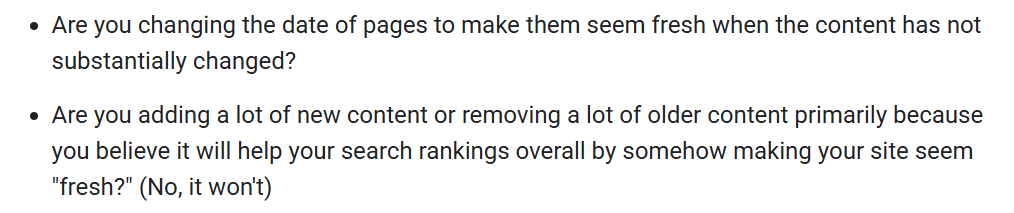
Google has clearly stated what doesn’t count as a ‘content refresh’3, and yes, it does negate the practice of changing the date from 2024 to 2025 in your blog titles!:
Where does one include an example?
To all places of the content where you are:
Explaining or clarifying concepts
Performing comparisons
Areas where visualizations help (using examples to create relatable scenarios)
Supporting facts or establishing trends
Showing what ‘success’ or ‘failure’ looks like
Providing instructions
These are what come to my mind – there could be more pockets in a content piece to fill with examples.
If you have already published ‘educational content’, you can try refreshing them using the above-mentioned tactics. They will make your content ‘easy to digest’ and ‘helpful’ to the consumer, and hopefully rank better.
Sources of ‘examples’ to include in your content
I have tried to broadly categorize types of example sources one can add to their content. If you have more, do share them in the comments!
Source 1: Customer stories
You can include customer stories as ‘case studies’ or quotes on how they solved a problem that your blog post focuses on. This is the best way to assert authority, build trust, and showcase successful experiences with your brand.
Also, only your brand can use this example – no one else, making it unique!
Many brands will publish case studies and never use them again on other content assets. That’s a huge missed opportunity. Not only does it help with interlinking, but helps hammer into the blog reader’s mind that your solution works for the problem stated in the blog.
Fear that you will sound ‘salesy’?
Be useful – the customer story should be relevant to the context of the blog.
Speak about the process and then share the result.
Keep it short and impactful – link to the case study for the reader to explore more on their own.
Source 2: Interview SMEs
One of the best ways to bring authority to your content is to onboard subject matter experts (SMEs), interview them, and include their wisdom in the blog post. The more influential the SME, the better (we at Merrative are working on making it easy to find and onboard real SMEs soon! 😁 )
For example, Harry Dry publishes one of my favorite newsletters, Marketing Examples. He usually authors his research or findings, but for this particular issue on Hacker News4, he onboarded an expert:
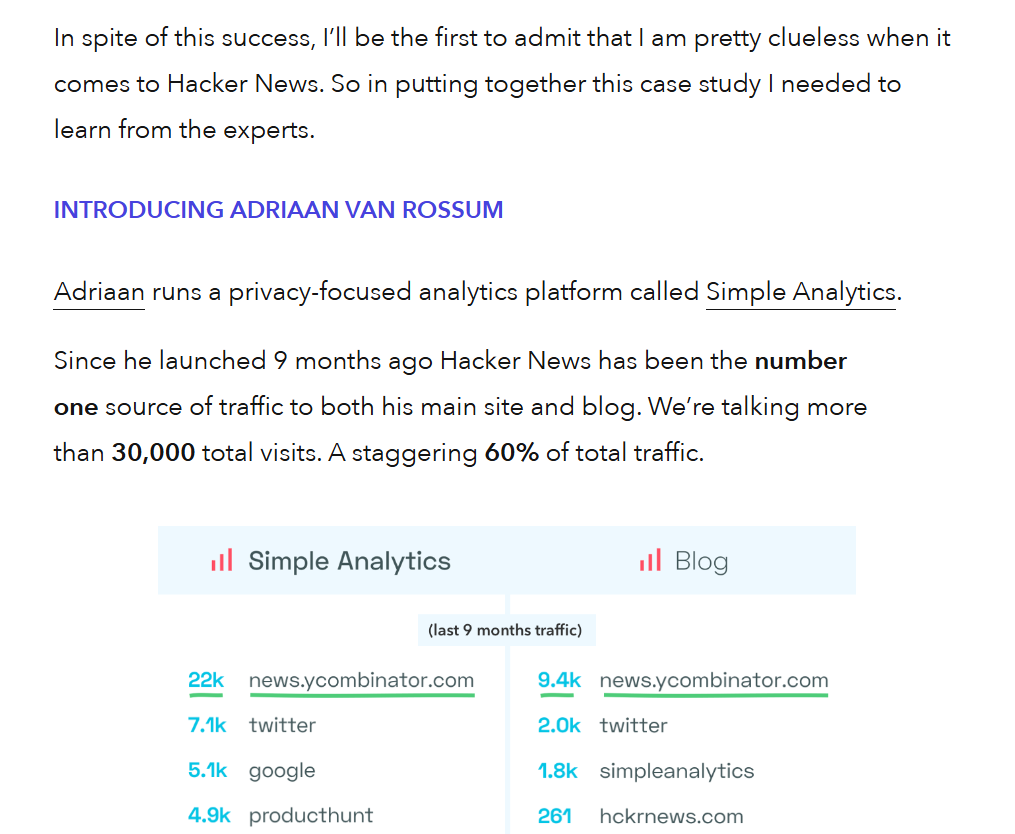
The whole newsletter issue covers details on how his SME mastered virality on Hacker News with screenshots of results and examples.
With this, Harry’s newsletter banks on his SME’s expertise, experience, and subject authority to continue building trust with his audience.
Source 3: Internal teams
Many expert content marketers have advised tapping into the knowledge of internal teams for blog post ideas, quotes, insights, and even article contributions. This is especially true for the ‘product-led content’ strategy.
The same goes for sharing examples.
Writing a blog post on a new feature release? Add quotes from the team who worked on it. They will be able to articulate it the best!
Identify SMEs within your internal team – some blog topics may overlap with their expertise making them eligible for quotes.
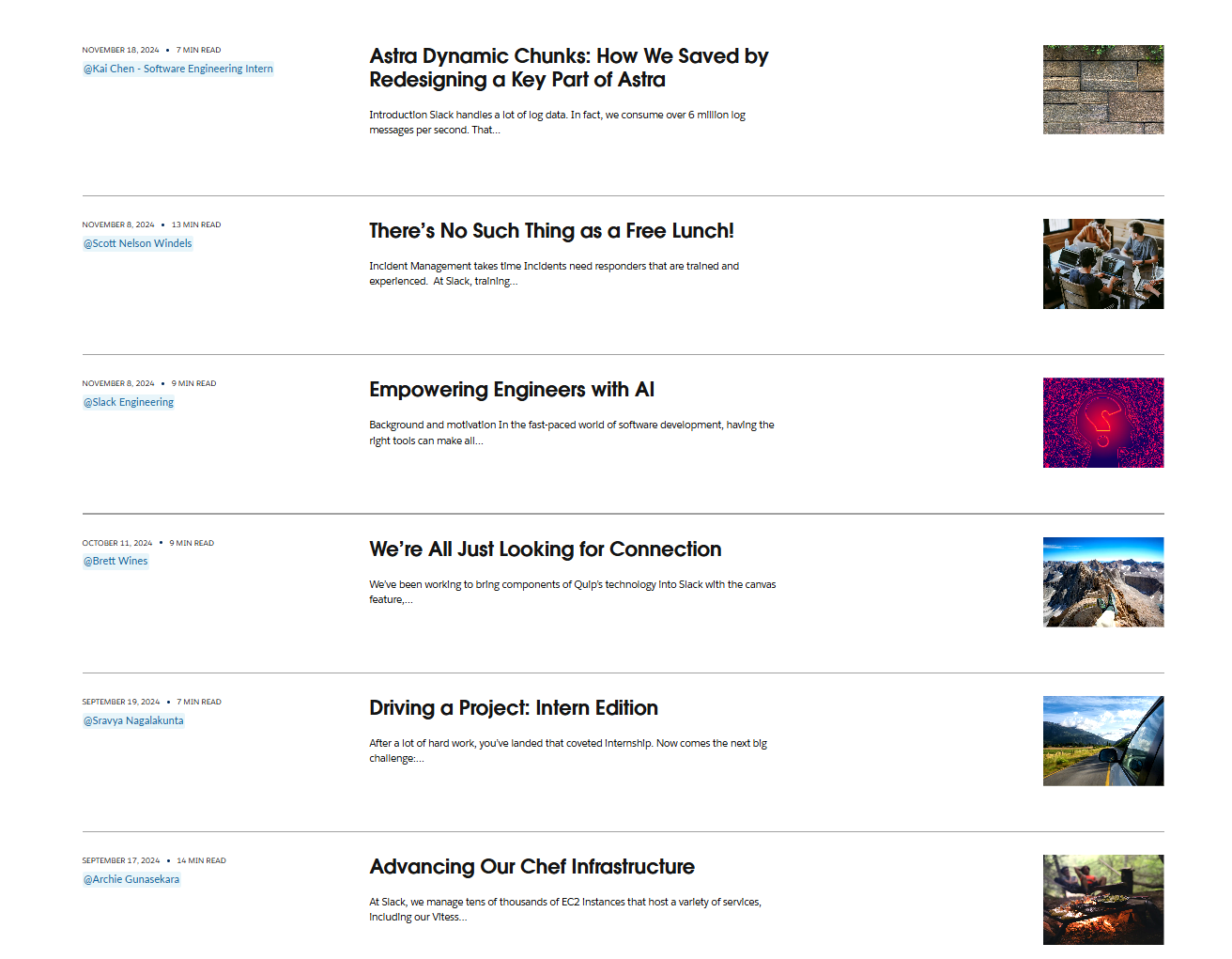
Slack went a step ahead and has a dedicated blog ‘Engineering at Slack’ where their employees share blog posts on various software engineering topics, success, and initiatives taken by their team.
We have written a detailed case study on Slack’s content marketing strategy.
Source-1 requires customers, Source-2 requires effort, and Source-3 requires internal systems for knowledge capture. Not every company has the bandwidth for them, although these would give the best results.
The subsequent examples require good research and less effort in comparison.
Source 4: News
Sharing the latest news as sources for example within the blog is one of the easiest and best ways to bring authority. The more recent the news, the higher the chances of it ranking for those ‘news’ specific keywords too.
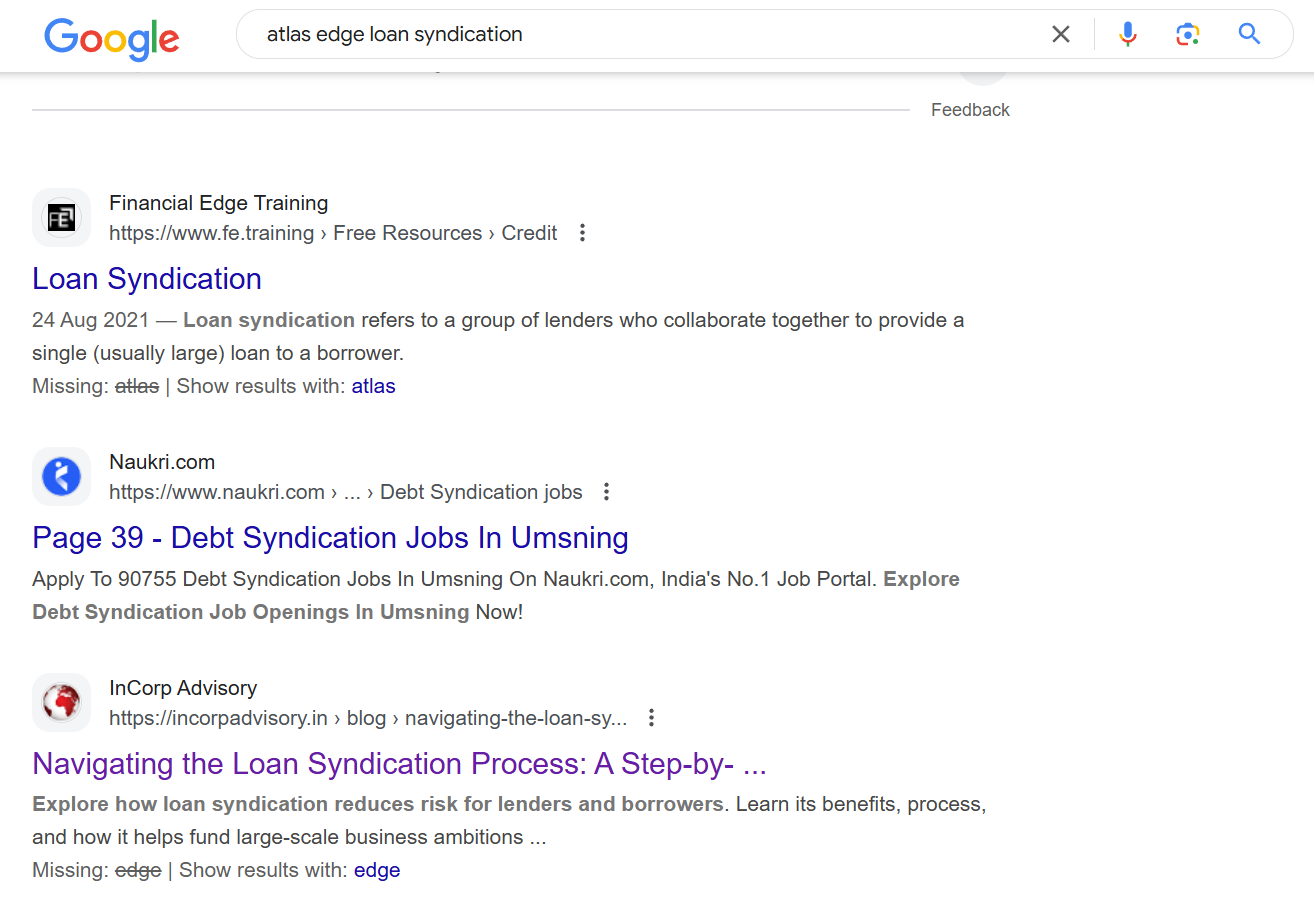
For example, in this blog post5 we wrote for one of our clients, we used a recent loan syndication news from the company AtlasEdge to explain the concept of loan syndication and its benefits:
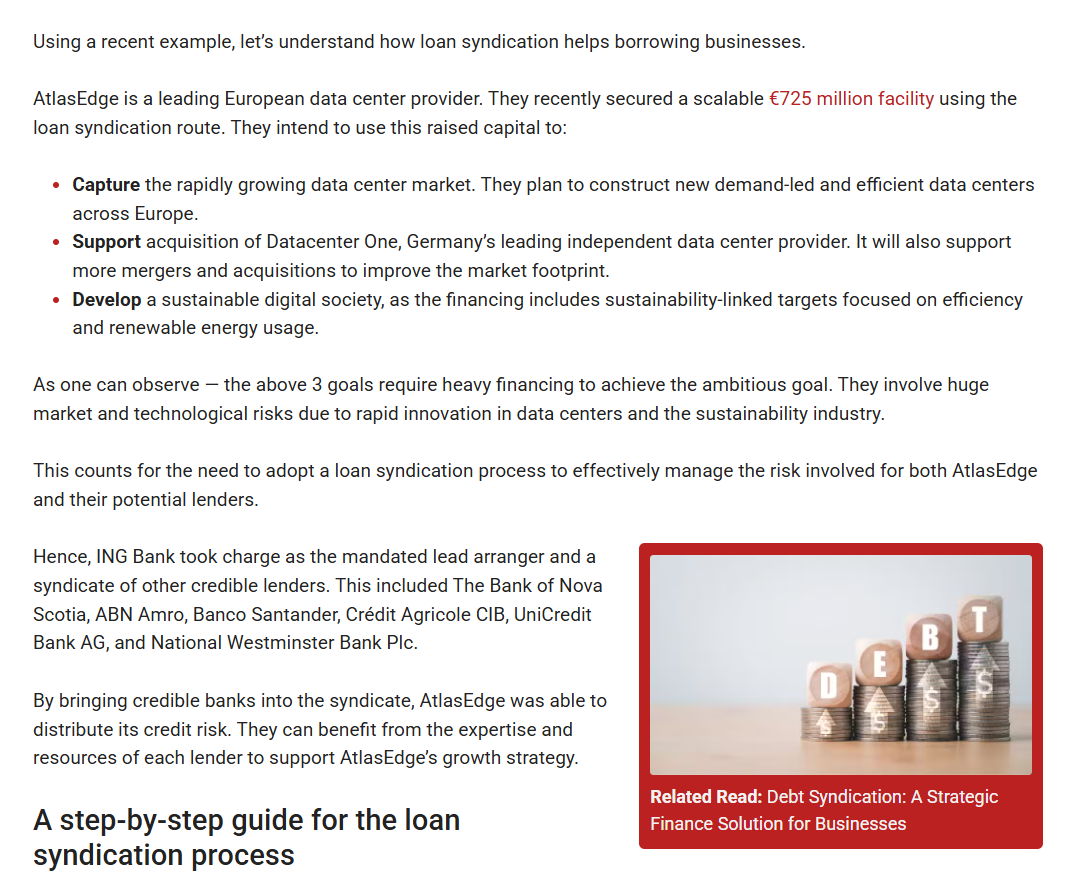
Now, if anyone searches for this development in the data center space, our client’s blog gets shown on the first page of Google!
I have used this trick of including ‘trending news’ in my blogs which makes them seem fresh and on-trend, and it has worked to improve rankings.
Want us to help you write high-quality and ranking blog posts like this?
Source 5: Social media posts
Many professional writers first scout social media sites like Twitter or LinkedIn to find good quotes related to the blog topic. These are the easiest source of examples requiring less time, provided you know boolean search tricks within social media.
For example, for my guest post on Buffer6 on LinkedIn thought leadership, I wanted to include an example of an employee sharing their achievements within the company in the best format. I scouted LinkedIn for hours and found one such post suitable to include:
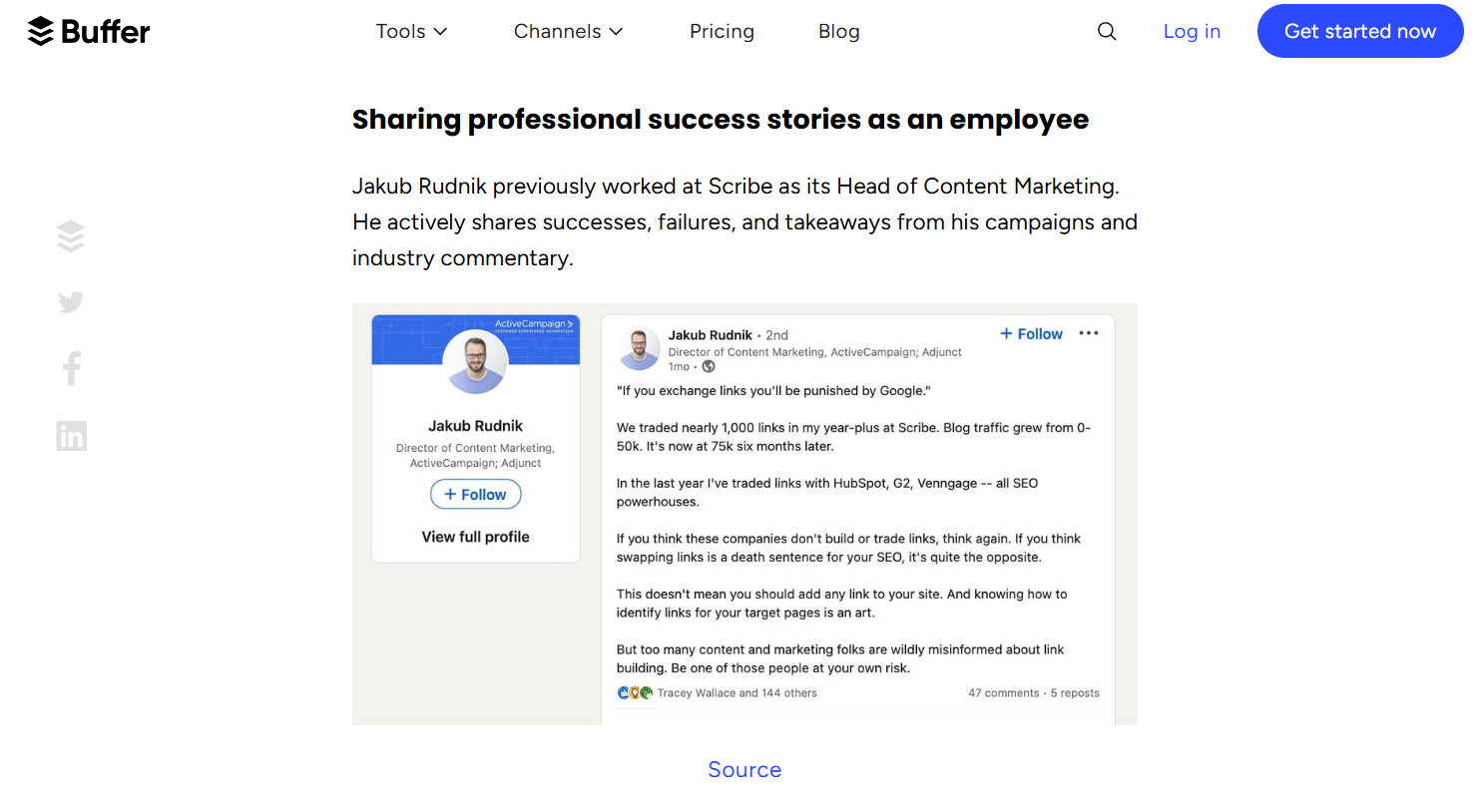
Adding this example helped me guide my reader on what a good post looks like for that section.
Many writers scout for posts that suit their blog’s needs to showcase expertise. This also highlights how posting on social media helps get backlinks and improves personal branding too!
Source 6: Primary research
You can always run surveys and polls within your network to capture original data that’s relevant to your content asset. This may take time, but content assets that include original statistics also help with generating backlinks, further improving SEO.
For example, here’s Ryan Law raising a survey request on LinkedIn with his network about the impact of AI on content marketing for a research report under Ahrefs:
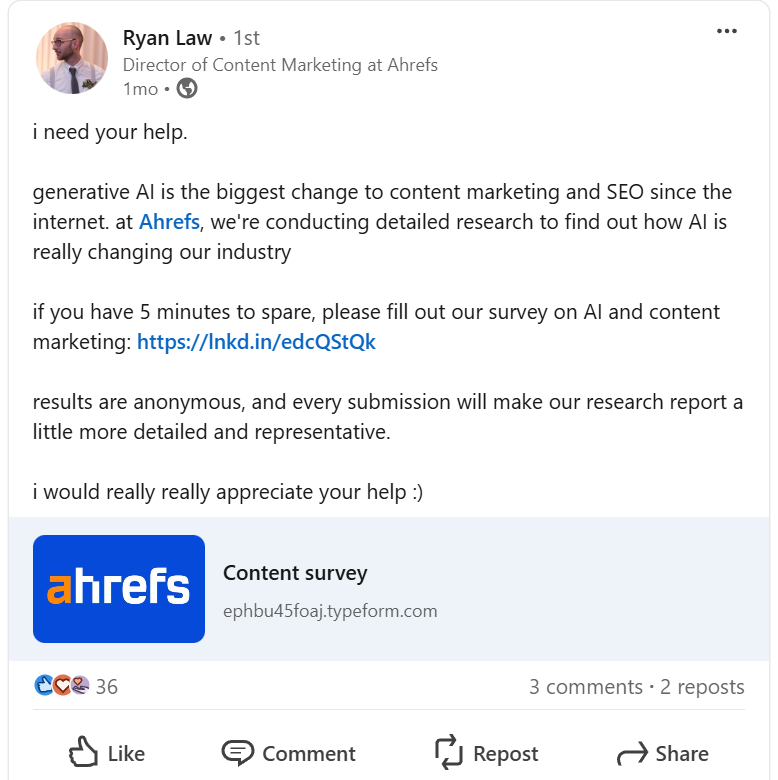
These are often one-time efforts with future updates to update statistics. One can always repurpose the results from such surveys into blog posts. For maximum utility, create surveys relevant to topic clusters instead of a single niche topic.
Source 7: Link to statistics
How are statistics a form of ‘example’?
Well, statistics emphasize your point by sharing the percentage of people who agree with it or highlighting a broad-level trend. This helps build trust and upgrade your point from a mere opinion to a fact.
For example, in this blog post by PenFriend AI, you can observe every point made, they included a fictional example to demonstrate it. They end the paragraph with a statistic from a reputable source to further emphasize the point, helping the whole section establish authority.
Source 8: Link to other publication’s quotes
I included this in the last because it’s my least favorite way – it feels like stealing. So ensure you provide a link to the original source.
For example, in this blog post, Forbes covers how ADHD is a superpower for entrepreneurs. They have linked to a quote from an interview published by Additude Magazine to emphasize this concept.
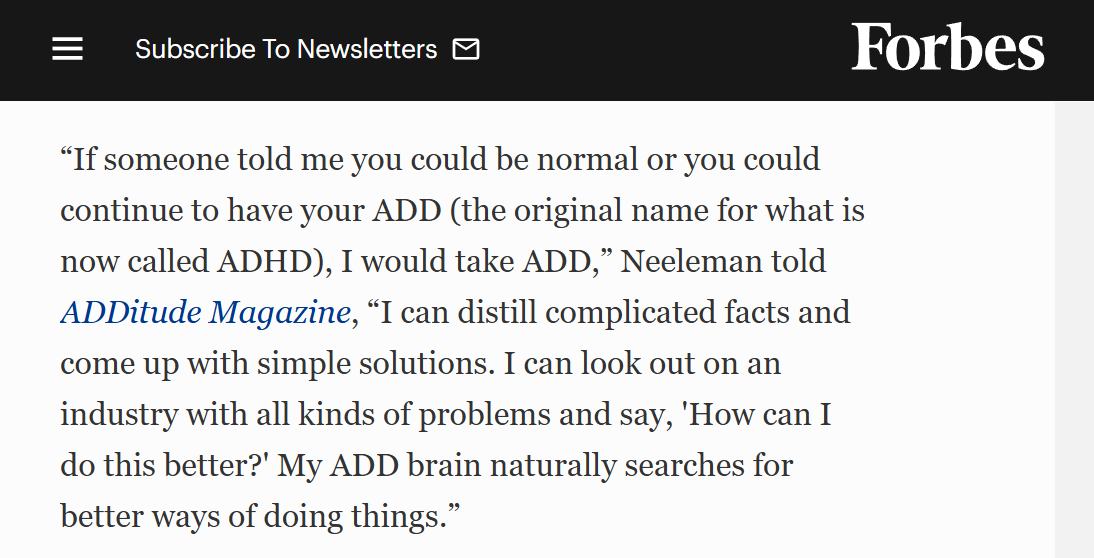
If the linked publication is not your direct competitor, you can link to their site, especially if their content’s topic falls into the blog’s topic you’re writing.
What do you think of ‘example-led’ content?
I know – adding examples in various forms isn’t a new concept.
It’s just that, in today’s content publishing landscape, one cannot really slack off in this department. Taking it seriously is one of the first few steps to achieving ‘people-first content’. Consider this newsletter as a reminder!
Hope you can use this content marketing example for your brand – and if there are any corrections, do let me know! 🙂
Next on Media First Brand
I will be covering how to use AI to make mini tools as content assets. I will include a small tutorial too – as I am myself learning it to help my existing clients create them.
I strongly believe that today, with AI content ruining SEO, it is more important to create content experiences via tools, calculators, actionable content, etc to establish brand authority.
I plan to get consistent with this newsletter in 2025 to publish one issue per month – so do stay tuned and read the newsletter within 4 weeks for free access!
Read our past content marketing case study issues on Slack, MailChimp, First Round Capital, and Harvard University.
Explore more content marketing examples for inspiration.
Do you know a company or a creator whose content you think I should cover? Let me know in the comments!
Also, if you found this newsletter useful or insightful, do help me grow it by sharing it with your network 🙂

Merrative is a community of 4500+ subject matter experts across professional writers, analysts, scholars, and journalists to create and discuss thought-provoking content.
We curated the top 5% of niche writers and subject matter experts to help brands and creators with thought leadership content formats:
Narratives: Interview customers, subject matter experts, or your management team to publish thought leadership blog posts, branded books, or guides.
Data storytelling: Analyze internal or external data to produce reports, data visualizations, data dashboards, and whitepapers.
Webinars: Repurpose webinars or podcasts into SEO blogs and social media posts.
Our talent pool has worked with leading brands, holds industry and academic expertise, and has at least 5 years of work experience.
HubSpot’s SEO collapse: What went wrong and why? – by Search Engine Land
How to get 30,000 Hacker News visitors to your website by Marketing Examples – [image source for ‘Interview SMEs’ as an example source]
Navigating the Loan Syndication Process: A Step-by-Step Guide by InCorp Advisory – [image source for ‘News’ as an example source]
How I Designed a LinkedIn Thought Leadership Content Creation System by Harshala Chavan on Buffer – [image source for ‘Social media posts’ as an example source]
Discover more from
Subscribe to get the latest posts sent to your email.